
If you're sorting out long-term accommodation on Koh Samui for a DTV visa, you're not alone — the Destination Thailand Visa drew tens of thousands of remote workers and freelancers in its first year, and many of them are now looking for somewhere to actually live on islands like ours. We're Arthur and Grace, and we manage two long-term townhouses at Park Samui directly, so this guide comes from the landlord's side of the lease, not a brochure.
The DTV changed the maths for long stays. It's a five-year, multiple-entry visa with stays of up to 180 days per entry — so your accommodation choice stops being a holiday booking and becomes a place to live for months at a time.
Key Takeaways
- What is the DTV visa? A five-year Destination Thailand Visa for remote workers and freelancers, with stays of up to 180 days per entry. It makes long-term accommodation a practical decision, not a holiday booking.
- Where do DTV holders live on Koh Samui? Mostly the northeast — Plai Lem, Choeng Mon, and Bophut. The best long-term house options sit in managed communities near the airport.
- What does it cost monthly? Our Superior Town House starts at THB 45,000/month and the Deluxe Town House from THB 50,000/month. Standalone villas often run far higher.
- What matters most? Fibre internet, a real workspace, predictable utility rates, and a landlord who responds. Beach photos come last.
- Townhouse, villa, or house? For most DTV residents, a townhouse in a managed community is the best trade-off between space, cost, and maintenance.
What the DTV Visa Means for Your Accommodation
The DTV isn't a tourist stamp — it's a long-term commitment, and your accommodation should match it.
A short-term rental is a holiday booking: fine for two weeks. A long-term rental tied to a DTV visa is a different decision — you're choosing somewhere to live, not somewhere to stay.
When you can legally stay 180 days at a time, you stop thinking in nights and start thinking in months. That changes what you should be looking for: predictable utilities, reliable internet, a workspace that actually works, and a lease that protects you — no sudden price hikes or mid-stay surprises, just a home that's secure for the length of your stay.
Why Koh Samui Works for DTV Visa Holders
Koh Samui sits in a sweet spot for long-stay remote workers: an international airport, real hospitals, decent supermarkets, and fibre internet in the right neighbourhoods.
It's a premium market, though, and worth knowing that going in — a 2025–2026 market snapshot put median villa rents around THB 105,000–107,000/month, so the high end is genuinely expensive.
You don't need a six-figure villa to live well here. A townhouse in a managed community gives you shared pools, a gym, gardens, and neighbours at a fraction of villa pricing. Choose the right neighbourhood and Samui is a genuine lifestyle upgrade; choose the wrong one and you'll be breaking a lease six months in.
Park Samui Townhouses: Built for Remote Work
This is where we can speak from direct experience. We live on-site at Park Samui in Plai Lem, on the northeast coast, with easy access to the airport and Choeng Mon Beach.
Both townhouses were set up with long-term remote work in mind: dedicated fibre internet, a proper workspace, and lease terms designed for stays of six to twelve months.
Superior Town House — from THB 45,000/month
Best for: solo remote workers and couples who want a comfortable, well-connected base without villa pricing.
What's included:
- High-speed fibre internet suitable for video calls and uploads
- A dedicated workspace for productive days
- Weekly cleaning built into the rent
- On-site gym and two 18-metre community pools
- 24-hour security
- Direct owner management — you deal with us, not an agency
Monthly pricing: from THB 45,000/month in low season, THB 50,000/month on a 12-month contract, and THB 60,000/month on a 6-month contract. See the pricing and availability page for the full seasonal calendar.
Deluxe Town House — from THB 50,000/month
Best for: couples, small families, or remote workers who want sea views and more room to spread out.
The Deluxe is a 170 sqm townhouse with panoramic sea views, a fully upgraded interior, two bedrooms and three bathrooms, and a private terrace.
Monthly pricing: from THB 50,000/month in low season, THB 60,000/month on a 12-month contract, and THB 70,000/month on a 6-month contract.
Where DTV Residents Actually Live
When you're choosing where to live long-term, four things matter more than the beach photos: infrastructure, noise and traffic, rental pricing, and commute tolerance. On all four, the northeast corner usually wins. The honest breakdown:
- Plai Lem / Choeng Mon — quiet, green, close to the airport, with strong fibre coverage. Best for remote workers who value calm and a short airport run.
- Bophut / Fisherman's Village — more restaurants and nightlife, and walkable; busier, pricier, and noisier in peak season.
- Chaweng — maximum infrastructure, maximum noise. Good for the buzz, a poor fit for deep-focus work.
- Lamai — cheaper and more local, with fewer amenities. A trade-off of savings for convenience.
- Maenam / west coast — affordable and relaxed, but a longer commute to the airport and the main hospitals.
For a fuller picture of each area, see our Koh Samui house rental guide.
What to Check Before You Sign
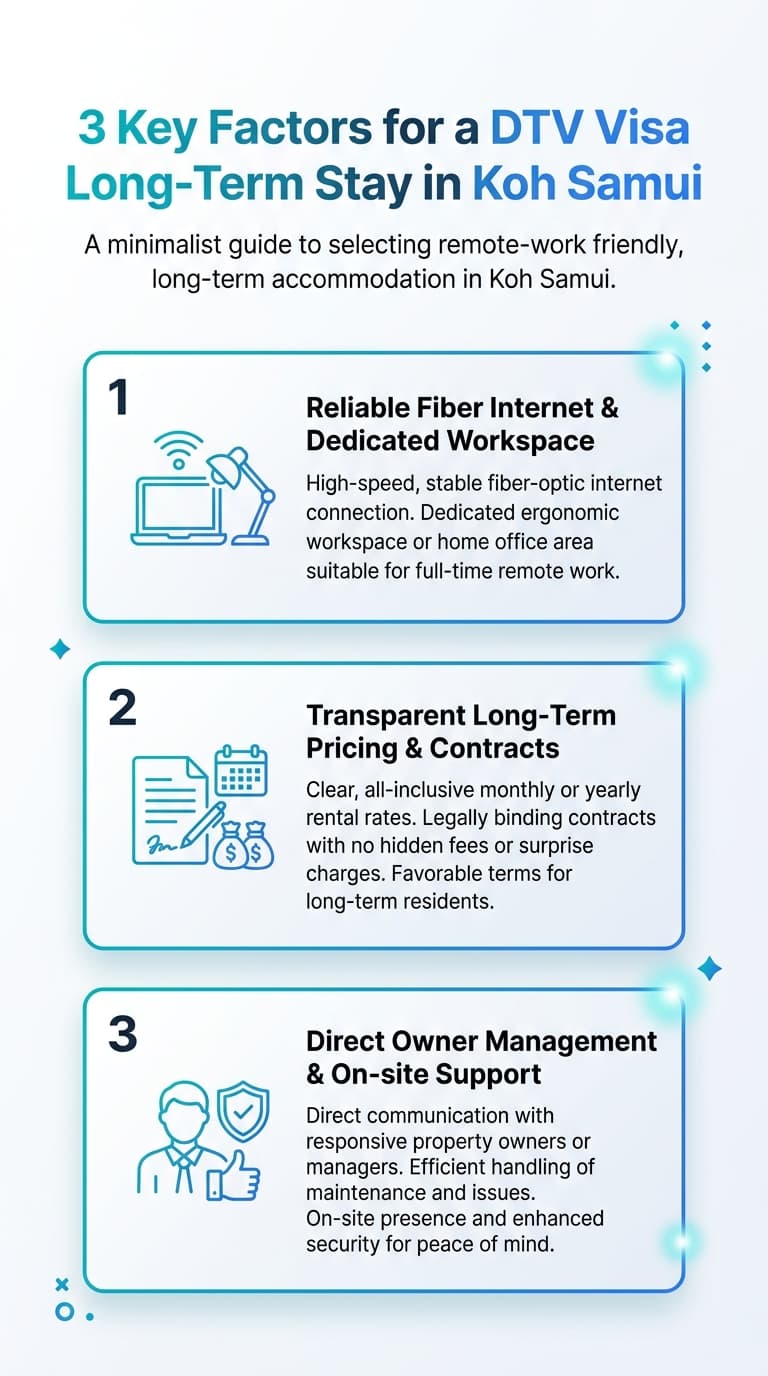
The vocabulary on Samui listings is loose: "villa" can mean a luxury estate or a two-bedroom concrete box, and "fast internet" can mean anything. For a DTV stay where you'll be working from home, these are the things that actually matter:
- Internet, tested and named. Ask for the provider, the plan speed, and whether it's fibre or mobile. A real fibre line is non-negotiable for remote work.
- Utility rate traps. Confirm whether electricity is billed at the government rate or an inflated landlord rate. Air-con runs constantly here, so it adds up fast.
- Lease terms in THB. Rent, deposit, and notice periods should be stated clearly in THB — never hidden behind "contact for price."
- Maintenance burden. In a managed community, the pool, gardens, and security are handled. In a standalone villa, that burden usually lands on you.
- The workspace. A kitchen table is not a workspace. Look for a dedicated desk area with good light and a stable connection.
As a filter: listings with genuine photos (not stock shots), rates stated in THB, and detailed descriptions of utilities, internet speed, and the immediate neighbourhood are the ones worth enquiring about.
DTV Koh Samui Accommodation Pricing
Here's how the common options compare. Longer contracts almost always lower your monthly rate.
- Superior Town House (Park Samui): THB 45,000–60,000/month — solo nomads and couples.
- Deluxe Town House (Park Samui): THB 50,000–70,000/month — couples, small families, sea views.
- Mid-tier private villa: roughly THB 60,000–90,000/month — space-seekers willing to manage the upkeep.
- Premium pool villa: around THB 105,000–107,000/month at the median — high-budget, privacy-first.
You can see the full seasonal calendar and current rates, all in THB, on our pricing and availability page.
Owner-Direct vs Agents
We run this on an owner-direct model on purpose. When you rent from us, you're dealing with the people who actually live at Park Samui — not a rotating cast of agents.
What that means for a DTV resident:
- No agency markup on your monthly rent
- Direct responses, usually within 24 hours
- A one-month deposit to reserve, with clear terms
- A landlord on-site when something needs fixing
If owning rather than renting is on your radar, we occasionally list a Park Samui townhouse for sale with full Thai freehold ownership. You can read more about us, or reach us through the contact form.
Conclusion
Long-term accommodation for a DTV visa comes down to being honest about your priorities: fibre internet over beach photos, predictable THB pricing over vague promises, and a landlord who answers over an agent who disappears once the deposit clears.
For most DTV holders, a townhouse in a managed community is the best trade-off between space, cost, and maintenance. That's what we offer at Park Samui, and we're happy to talk through whether it fits your plans.
Frequently Asked Questions
Is Koh Samui a good place for DTV visa accommodation in 2026?
Yes, if you value strong infrastructure and don't mind a premium market. Koh Samui has an international airport, fibre internet, and managed communities well suited to a DTV long-term stay, though monthly rents sit above mainland hubs like Chiang Mai.
How much does long-term accommodation cost on Koh Samui for a DTV holder?
Townhouses at Park Samui range from THB 45,000 to 70,000 per month depending on the unit and contract length, while premium villas reach a median of around THB 105,000–107,000/month. Longer leases consistently lower your monthly rate.
What should I look for in DTV accommodation on Koh Samui?
Prioritise tested fibre internet, a dedicated workspace, government-rate electricity, and clear lease terms in THB. For remote work, a reliable connection and a real workspace matter far more than the view in the listing photos.
Are townhouses better than villas for DTV long-term stays?
For most DTV residents, yes. A townhouse in a managed community gives you shared pools, a gym, gardens, neighbours, and 24-hour security without the maintenance burden of a standalone villa — at a lower monthly cost.
Can I rent directly from owners instead of through an agency on Koh Samui?
Yes. We manage our two Park Samui townhouses owner-direct, which removes agency markups and means you deal with us throughout your stay.
How long can I stay in Thailand on a DTV visa?
The DTV is valid for five years and allows stays of up to 180 days per entry, extendable once. That length makes committing to a long-term rental on Koh Samui sensible rather than a string of short bookings.
Is Park Samui suitable for remote work on a DTV visa?
It's built for it. Both townhouses include high-speed fibre internet and a workspace designed for productivity, in a quiet Plai Lem community close to the airport and Choeng Mon Beach.